The Journey That Changed Everything
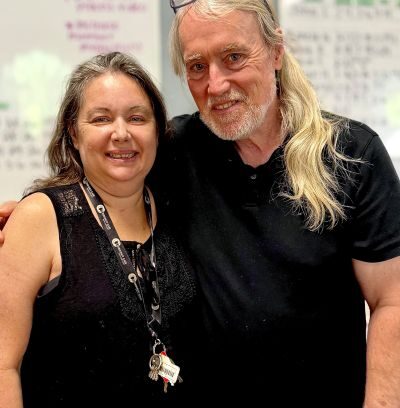
“For me, mental health recovery is not about erasing the past or erasing the fact that I have a mental illness,” Mark says. “It is existing with it and learning to deal with it in a better way.”
Mark Hilton first came to Bell in 1983. He was 20 years old.
“When I first started this journey, I just didn’t want to hurt anymore. My very first day at Bell, I was ready to end my life,” he recalls. “The person I talked with convinced me to stay.”
“I had so many issues with my mental health,” he shares. “I left school after my first semester. At the time, I thought success meant doing something difficult like becoming a doctor and making a lot of money. Looking back now, I see my motivation wasn’t great.”
“With the job I have at Bell, I just want to be helpful. That is my version of success,” Mark explains.
For more than 12 years, Mark has worked at the Drop-In Center, using his lived experience to encourage, support, and advocate for others navigating their own mental health recovery journeys.
“Over the years, I have realized that the experiences I have had in my life can help someone else who is going through similar things,” he says. If I have made a difference in one person’s life, then it is worth it, because someone did that for me when I first came to Bell.”
For Mark, recovery has never been a short destination, but instead a well-traveled path.
“Recovery is all about changed behavior,” he explains. “If you want to get well and stay well, it is a lifelong commitment. It doesn’t happen overnight.”
For years, he struggled with medication routines, hospitalizations, and trying to manage everything on his own.
The last time he was hospitalized was in 2010. “I said to myself, I am tired of going back and forth with this mental health stuff,” Mark says. “Maybe I can find whatever means I can to stay well, and that is what I have been doing every day for the past 16 years.”
Today, he focuses on routines and tools that help him stay grounded.
Each morning, he sits quietly and reflects on the day ahead. He attends support groups regularly and surrounds himself with people who also focus on wellness, recovery, and growth.
“You see other people and learn what they did and think, maybe I can do that too,” he shares.
Over the years, Mark has learned the importance of shifting his focus outward.
“I try to put myself to the side and listen to others each day,” he reflects. “Being able to help someone else gives my life purpose. Having purpose is a very good thing,” he says. “I didn’t always have that.”
“I tried to run away from my problems and keep things going the best I could,” he explains. “I would try to juggle everything, and now, I realize that was my best effort at the time.”
That understanding has helped him approach recovery with more compassion toward himself.
“For me, mental health recovery is not about erasing the past or erasing the fact that I have a mental illness,” he explains. “It is existing with it and learning to deal with it in a better way.”
That mindset has helped Mark create a life filled with meaning, relationships, joy, and purpose.
At the Drop-In, Mark creates moments of connection and belonging for others. Whether it is a trip to a local park, an antique mall, going out to eat, getting ice cream, or the annual beach trip.
“People can let loose a little bit and be themselves, and I enjoy being a part of that,” he says.
He also leads groups, something he deeply values because he understands firsthand how powerful connection and encouragement can be.
Part of Mark’s recovery has been learning to appreciate everyday moments.
“I like to walk,” he says, smiling as he talks about the breeze, the sunshine, and simply being outside. “Sometimes those little things are the best part of your day.”
He journals regularly, especially during difficult moments.
“When I am all jammed up with something, I write about it,” he explains. “Then I look at it the next day and think, okay, this is what I did to get out of it.”
He also finds comfort in reading, visiting bookstores, going to the movies, singing, and spending time with others.
“I don’t know if anyone else likes hearing me sing,” he laughs, “but I like it.”
Over time, he has learned that difficult emotions do not have to control the direction of his day. “If emotions come or a thought comes and I dwell on them, it makes matters worse,” he says. “At this point, I might decide to read, take a walk, talk to somebody, or play music. You don’t have to get stuck.”
Mark credits many people and experiences for helping shape his recovery journey: his mother, the groups he attends, his partner Jenn, and the people at Bell.
Some of his favorite memories involve spending time with his mother after she helped him through some of his dark moments.
“She got me out quite a bit,” he recalls. “We went to all of the parks around here and traveled.”
As Mark’s mental health improved, he and Jenn began returning that same care and compassion to her.
“Jenn and I took her every week to the park, out to eat, to get coffee,” he shares. “The last ten years, we had great times together. I would call her the best mom. She was so grateful to have children, and that meant a lot for me to hear.”
Looking back, Mark knows recovery was not just a simple solution; it took dedication, support, time, and people who believed in him when he struggled to believe in himself.
“So many things have been critical in getting to a place where I feel pretty good about my mental health,” he says. “Bell was definitely the first. I am still here, and I feel blessed to be here.”
When asked what he would tell his younger self in 1983, Mark pauses and smiles.
“I would say, you know what? You are going to be okay. It’s not as bad as it seems right now.”
For others struggling with mental health challenges, his advice is this: “Be open-minded. Learn new ways or ideas. “Sometimes a new perspective can change a lot of things.”
And above all: “Definitely don’t give up. Have faith that things can get better.”
More than four decades after first walking into Bell, Mark now spends his days helping others believe recovery is possible, too.
“My job truly brings me a lot of joy,” he says. “I never mind going to work. I was so disappointed in life when I first came to Bell, but today I’m not,” Mark shares. “Life turned out pretty great.”
For Mark, that is the definition of success.